
In systems where movement does not follow a perfectly linear axis, spherical plain bearings and rod ends play an essential role. They accommodate oscillatory movements and angular misalignments, contributing to the precision and durability of the application, even when transmitting tensile and compressive loads.
The MBI range includes different configurations, selected based on load conditions, working environment, and maintenance requirements. Relubricable or maintenance-free versions are available, in stainless steel or with PTFE lining.
Rod ends consist of a spherical inner ring inserted into a housing with a shank. This structure allows system parts to be connected and tensile and compressive loads to be transmitted even in the presence of misalignments.
Different configurations are available based on the connection characteristics:
Shank with external thread for screwing into the component.
Shank with internal threaded housing.
Configuration with clockwise screwing.
Configuration with counter-clockwise screwing.
Operating conditions and the possibility of scheduling interventions influence the choice of rod end. The MBI range includes two main families, distinguished by coupling type and maintenance needs.
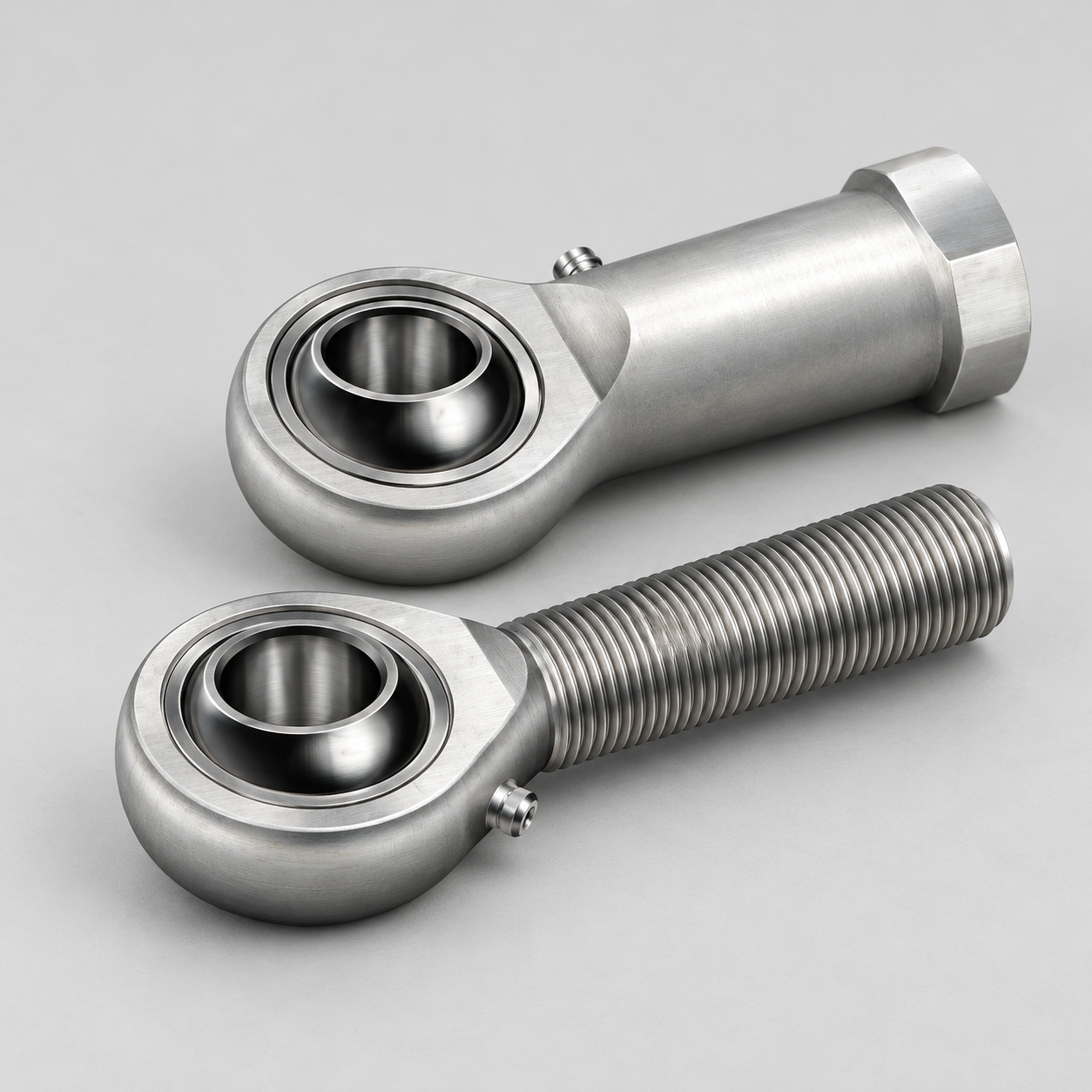
The JF and JM series feature a steel-bronze coupling and require periodic relubrication. They are suitable for applications where maintenance can be scheduled based on work cycles and operating conditions.

The JFT and JMT series use a steel-PTFE coupling and are maintenance-free. They reduce component interventions and are suitable for systems where accessibility or continuous operation are priorities.
Spherical plain bearings consist of an inner ring with a spherical outer surface, inserted into an outer ring with a corresponding inner surface. Unlike rod ends, they do not have a body with a threaded stem. This structure determines their behavior within the system:
Accommodate changes in position between components.
Compensate for inclinations and alignment differences.
Support stresses generated during operation.
They are mounted directly into the housing provided by the design.
Spherical plain bearings and rod ends are used in numerous systems and equipment, from industrial automation to agricultural applications. Their diverse uses help us understand the role these components play within the mechanical connection.
Once the application is defined, the choice of component depends on how it needs to be connected to the system and the conditions expected during operation. Several aspects help identify the most suitable configuration.
The presence of a dedicated housing or the need for a threaded shank guides the choice between a spherical plain bearing and a rod end.
The amplitude of oscillations and misalignments must be compatible with the system's geometry.
The stresses to be transmitted and the frequency of movements affect the component's characteristics.
Accessibility, possibility of relubrication, and operating conditions help define the most appropriate version.
MBI evaluates connection characteristics and operating conditions to guide the choice towards the configuration most consistent with the application.


